“I eat pretty healthy.”
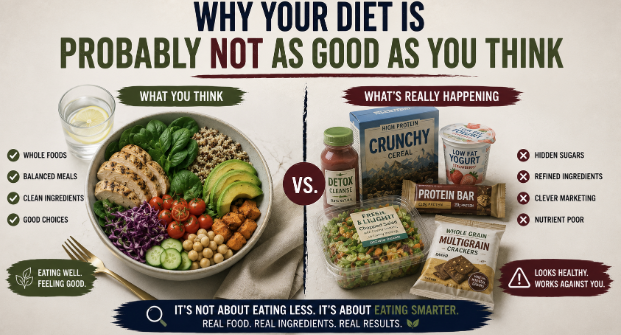
Providers hear this dozens of times a day. The patient is not lying. They genuinely believe it. They’re buying the cereal with protein on the box, the granola with low sugar on the label, the plant-based “chicken” that looked reasonable on the package. They’re avoiding junk food, more or less. They’re doing what they’ve been told.
Then you ask what they ate for breakfast. Toast. They say it with confidence. Toast and maybe some orange juice.
No protein. A blood sugar spike followed by a crash. Two hours later they’re foggy and tired and looking for caffeine to get through the morning. And they don’t connect any of it to what they ate, because what they ate was “healthy.”
This is the gap that most conventional care never closes.
The “Eating Healthy” Misunderstanding
The problem isn’t that people aren’t trying. It’s that the definition of “healthy eating” has been shaped by decades of misleading marketing, outdated guidelines, and a food industry that profits from confusion.
Low fat was the message for thirty years. Products stripped of fat and loaded with sugar got to carry the “low fat” label. Margarine was healthier than butter, so the marketing said. The result was a population eating less fat and more sugar, while metabolic disease climbed steadily.
Now protein is the message. It’s a more accurate message this time. Protein does matter. But the industry’s response has been to stamp the word “protein” on cereal, flavored milk, and bars that are fundamentally ultra-processed. The message gets used to sell the same products that caused the problem in the first place.
A protein bar that contains 15 ingredients you can’t pronounce, a handful of artificial sweeteners, and emulsifiers that disrupt the gut lining is not a health food. It is an ultra-processed product with a health claim on the front of the package.
What Ultra-Processed Food Is Actually Doing
Ultra-processed food is defined by its ingredients. Not calories. Not fat content. Not whether it contains protein. If the product contains things you wouldn’t use to cook a meal at home, emulsifiers, artificial flavors, modified starches, preservatives, it’s ultra-processed.
These additives cause specific, documented problems.
Emulsifiers disrupt the protective mucous layer in the small intestine. This increases intestinal permeability, promotes pro-inflammatory bacteria, and creates a chronic low-grade inflammatory state. That inflammation shows up as joint pain, skin conditions, digestive symptoms, and fatigue.
Flavor enhancers like MSG disrupt satiety signaling, meaning the brain doesn’t receive the “full” signal when caloric needs are met. You eat more without registering it. A bag of chips consumed in one sitting wasn’t a failure of willpower. It was the product functioning as designed
Added sugars and refined carbohydrates cause blood sugar spikes followed by crashes. Repeat this multiple times a day for years and you’re looking at blood sugar instability and eventually insulin resistance.
Research estimates that 85% of human disease is driven by poor diet. That’s not a number invented by the functional medicine world. It comes from the medical literature.
The Liquid Diet Nobody Counts
Here’s a scenario. Ask someone about their diet. They say it’s pretty good, not too bad. Then ask about alcohol. Well, they go out on weekends, maybe three or four drinks on Friday, a couple on Saturday. Not much during the week. Maybe one or two. Ask about soda. Oh, a couple cans a week, not more than that. Energy drinks? Well, they’re tired at work, so one at lunch, most days.
Put those together. It’s potentially 10 alcoholic drinks a week. A few sodas. A daily energy drink. Each one of those things seemed moderate in isolation. Combined, it’s a massive daily sugar and alcohol load that never got counted.
This is what compartmentalization does. The mind separates each habit and evaluates it as small. The body experiences all of them simultaneously.
The same thing happens with food. A small something in the morning, not a real meal. A salad for lunch. A few crackers while making dinner. A full meal at 7pm. The day looks balanced until you map it out and see that protein was effectively absent until the evening, blood sugar was unstable all day, and the body was running on stress hormones and caffeine to compensate.
What “Eating Well” Actually Requires
Protein at every meal is the single highest-leverage change most people can make. Not just once a day. Every meal. 20 to 30 grams, consistently
This regulates hormones. It supports muscle development, which matters especially over 35. It improves satiety so you don’t spend the afternoon fighting cravings. It provides the building blocks for neurotransmitter production. Nearly every complaint that patients walk in with, fatigue, brain fog, low motivation, weight gain, has some connection to inadequate protein.
Eggs are the most nutritionally complete food available. They contain every essential vitamin, nutrient, and amino acid. Two eggs with vegetables is a better breakfast than any cereal on the market, including the ones with “high protein” on the box.
The perimeter of the grocery store is where real food lives. Fresh produce, quality meat, fish, eggs. The center aisles are shelf life. Not because center-aisle food is universally bad, but because food engineered to last years on a shelf has been processed in ways that compromise its nutritional value and often add ingredients that cause the problems described above.
The Gut Absorption Problem
Here’s a piece most people miss entirely. You can eat a diet that looks excellent on paper and still be significantly deficient in key nutrients.
Gut health determines how well you absorb what you eat. If your gut lining is inflamed, if your microbiome is out of balance, if digestion is poor, the nutrients in your food are not being absorbed efficiently. You’re eating great food and getting a fraction of its benefit.
This is why two people can eat the same diet and have dramatically different nutrient levels. Their gut microbiomes are different. Their stress states are different. Their absorption capacity is different.
Chronic stress burns through B12 and magnesium rapidly. These nutrients fuel the nervous system and adrenal system. Someone under sustained pressure is depleting them faster than diet alone can replenish them, often without knowing it.
MTHFR is a genetic variant that affects how B vitamins are processed. People with this variant can take high-quality B12 and still not utilize it properly because of how their genetics handle methylation. They need methylated forms of B vitamins that bypass the impaired conversion step.
None of this shows up on standard blood panels unless someone specifically looks for it.
The Real Cost of “Just Eat Better”
Telling a patient to “just eat better” and sending them out the door is not nutrition counseling. It is the absence of nutrition counseling.
Most people trying to improve their diet don’t need to be told that vegetables are healthy or that fast food is bad. They need specific, practical guidance on what to actually eat, how to read an ingredient list, what to look for in a grocery store, and how to make changes that fit their schedule and budget.
Eating well can cost more. The cheapest ways to feed a family often involve ultra-processed food that is convenient, shelf-stable, and marketed to children. That’s a socioeconomic reality that deserves acknowledgment, not a lecture
But for many people who think they’re eating well and still feeling terrible, the problem is not money. It’s information. They’ve been navigating nutrition with guidance that was wrong, incomplete, or hijacked by the food industry.
A food journal for one week, written without judgment, is often enough to reveal patterns the person wasn’t aware of. That single exercise, without any other change, starts to make the invisible visible.
From there, baby steps compound. Replace one processed food. Add protein to one meal. Stop buying the thing that triggers overeating once you don’t have it in the house. Small, specific, sustainable.
That’s what eating well actually looks like in practice. Not perfection. Progress.
About the Author: This article was written by the clinical education team at Med Matrix, a functional medicine clinic in South Portland, Maine. Med Matrix serves over 3,000 patients with a provider team that specializes in root-cause testing, hormone optimization, and personalized treatment plans.